
Water softener installation for Phoenix’s very hard water
Valley tap water typically carries 10–20 grains of hardness per gallon — enough to crust faucets, spot every glass and shorten the life of your water heater. We test your water free, size a softener to your number, and install it in a single visit.
- Free in-home test
- Lifetime warranty
- Upfront written price
- Family-owned, local
The short answer
A water softener removes the calcium and magnesium that make Phoenix water hard by trading them for sodium (or potassium) on resin beads. It is the only common home system that actually removes hardness — which is what stops scale, spotting and soap scum. Sized right for your measured hardness, it pays you back in fixtures, appliances and cleaning time.
Two softener systems, one honest recommendation
Both are salt-based ion-exchange softeners paired with carbon, because Valley water brings two problems: hardness and disinfectant taste.
Complete Home System
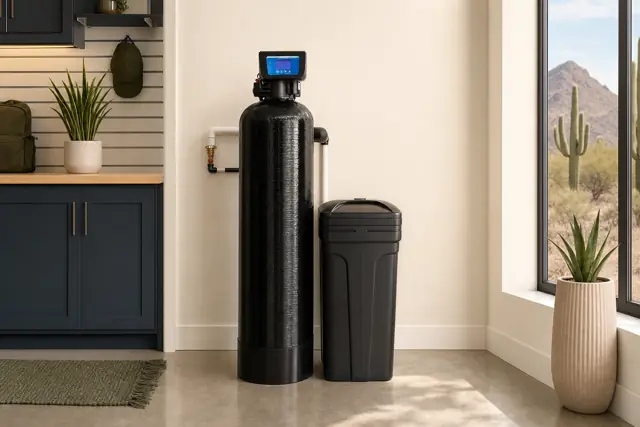
Two-tank setup: carbon pre-filtration plus a salt-based water softener.
- Removes hardness (calcium and magnesium) that causes scale
- Reduces chlorine/chloramine taste and odor
- Every tap, shower and appliance
Best for: Most Phoenix-metro homes on city water.
Softener with Chlorine Filtration
High-capacity softener with built-in carbon for chlorine reduction.
- Softens the whole home
- Chlorine reduction in one compact unit
- Sized to your measured hardness
Best for: Smaller homes, condos and tighter garage space.
Want great drinking water too? Add our tankless reverse osmosis — the Whole-Home + RO Bundle installs both in one visit.
How a water softener works
Hard water flows through a tank of resin beads that hold sodium ions. Calcium and magnesium stick to the beads more strongly than sodium does, so they swap places: the hardness stays in the tank, and a small amount of sodium goes into your water.
When the beads are full, the softener regenerates — it rinses them with salt water (brine) from the salt tank and flushes the hardness down the drain. A modern metered valve regenerates based on how much water you’ve actually used, so it doesn’t waste salt or water.
In our Complete Home System, water passes through carbon first, which reduces the chlorine or chloramine your city adds. That protects the resin and takes the “pool smell” out of your shower. Chlorine vs chloramine in Valley water.
What size softener does your home need?
Size comes from three numbers: how many people live in the home, about 75 gallons per person per day, and your hardness in grains per gallon. The result is your daily grain load. A good softener handles about a week of that load between regenerations — too small and it regenerates constantly; too big and the resin can channel and waste salt.
| People | Hardness | Grains removed per day | Typical capacity |
|---|---|---|---|
| 1–2 | 10 gpg | 1,500 | 24,000 |
| 1–2 | 15 gpg | 2,250 | 24,000–32,000 |
| 3–4 | 10 gpg | 3,000 | 32,000 |
| 3–4 | 15 gpg | 4,500 | 32,000–48,000 |
| 3–4 | 20 gpg | 6,000 | 48,000 |
| 5–6 | 15 gpg | 6,750 | 48,000–64,000 |
Rule-of-thumb sizing. We size from your measured hardness and actual usage, and add a margin for iron or high TDS if we find them. Full sizing guide.
What installation involves
- Softener loop. Many Valley homes have a pre-plumbed softener loop in the garage. If yours doesn’t, we add one — and price it in writing first.
- Drain and power. The softener needs a drain for regeneration water and a standard outlet for the control valve.
- Outdoor water stays hard on purpose. In most homes the loop softens indoor plumbing only, so lawns and plants aren’t watered with softened water. Why that matters.
- Programming to your number. We set hardness and regeneration from your test, then show you how to read the display and add salt.
- Bypass valve. Lets you take the system offline in seconds for maintenance.
Living with a softener
You’ll add salt (or potassium chloride) to the brine tank — how often depends on your hardness and water use. Resin typically lasts many years on city water with carbon protecting it from chlorine. We’ll remind you about carbon changes and check the system when you need us. Maintenance guide · How long softeners last in Arizona.
What a softener will — and won’t — do
Will
- Remove calcium and magnesium hardness
- Stop new scale on fixtures, glass and heating elements
- Let soap and shampoo lather and rinse easily
- Help water heaters and appliances keep their efficiency
Won’t
- Lower total dissolved solids (that’s reverse osmosis)
- Remove chlorine by itself (that’s the carbon stage)
- Cure eczema or any medical condition
- Dissolve heavy scale that’s already built up overnight
Water softener installation across the Valley
- Scottsdale
- Mesa
- Chandler
- Gilbert
- Tempe
- Glendale
- Peoria
- Surprise
- Goodyear
- Avondale
- Buckeye
- Queen Creek
- Paradise Valley
- Cave Creek
- Fountain Hills
Already have a softener that’s leaking, running constantly or not softening? See softener replacement.
Water softener questions
Do I really need a water softener in Phoenix?
If your water tests above about 7 grains per gallon and you’re tired of scale, spotting and soap scum, a softener is the only common home system that actually removes hardness. Most Valley utilities report averages well above that — see Phoenix water hardness by city. Some West Valley zones are much softer; we’ll tell you if yours is one of them.
How much does a water softener cost in Phoenix?
Installed salt-based softeners in the Valley commonly run from the low $2,000s to $4,000+, and bundles with carbon or RO cost more. Whether your home already has a softener loop matters a lot. See our Phoenix softener cost guide; your exact price is in writing after the free test.
What size water softener do I need?
Multiply people in the home × about 75 gallons per person per day × your hardness in grains per gallon. That’s your daily grain load; a softener should handle roughly a week of it between regenerations. A family of four at 15 gpg needs ~4,500 grains a day, which usually means a 32,000–48,000-grain unit. Full sizing guide.
Is softened water safe to drink?
Yes for most people. Softening swaps calcium and magnesium for a small amount of sodium — roughly 7.5–8 mg per liter for every grain of hardness removed. If you’re on a strict low-sodium diet, use potassium chloride instead of salt, or drink from an RO tap. More on sodium.
Will a softener make my skin and hair feel different?
Most people notice soap rinses off more easily and skin and hair feel less “squeaky.” Research on eczema is mixed — a UK trial found softeners didn’t improve eczema scores overall — so we never promise a medical result. What the research says about skin.
How long does installation take?
Most installs on an existing softener loop are done in a single visit of a few hours. Homes without a loop need extra plumbing, which we’ll explain and price before you decide.
What about salt-free softeners?
Salt-free “conditioners” don’t remove hardness — the minerals stay in the water — though some (template-assisted crystallization) reduce scale formation. If you want spot-free glass and slick-rinsing soap, you need a real softener. Honest comparison.
Find out exactly what’s in your water — free.
We test hardness, total dissolved solids and chlorine at your tap, show you the numbers, and recommend only what your home actually needs. If the honest answer is “you don’t need a system,” we’ll tell you that too.
- Results in front of you, in plain English
- Upfront written price — no day-of surprises
- Lifetime warranty on systems we install
- Local, family-owned, Phoenix metro & Maricopa County