
Reverse osmosis drinking water, right at your kitchen sink
Valley tap water meets federal standards — but it’s high in dissolved minerals and tastes like it. A tankless RO system lowers total dissolved solids for clean-tasting water, clearer ice and better coffee, without hauling another jug.
- Tankless, compact
- Remineralized for taste
- Filter-change reminders
- Free TDS test
The short answer
Reverse osmosis pushes water through a membrane with pores small enough to hold back most dissolved salts and minerals, plus carbon stages for chlorine taste. It is the most practical way to lower TDS for drinking water at home. It’s a point-of-use system: it treats one tap, usually the kitchen sink and fridge — not the whole house.
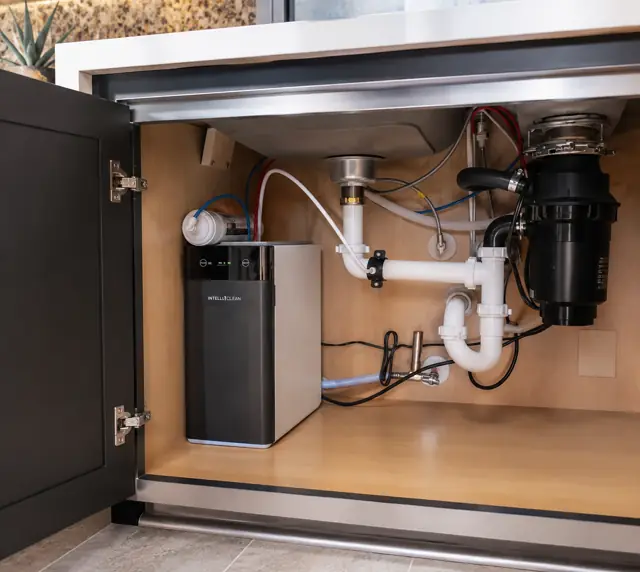
HW800 AlkaPro tankless RO
Our drinking-water system is a tankless, under-sink reverse osmosis unit with a remineralization stage that adds back a small amount of minerals for taste.
- Filters on demand — no storage tank hogging the cabinet
- Multi-stage: sediment, carbon, RO membrane, remineralization
- Built-in reminders when a filter is due
- Dedicated faucet; optional line to fridge and ice maker
Pair it with a softener as the Whole-Home + RO Bundle — one visit, one warranty. See softeners.
Why Phoenix homes buy RO
Phoenix-area water carries a lot of dissolved material — calcium and magnesium (hardness) plus sodium, chloride and sulfate picked up from the Colorado, Salt and Verde rivers and from groundwater. Many Valley utilities report average TDS above the EPA’s 500 mg/L secondary guideline, which is a taste and aesthetics guideline, not a safety limit. That mineral load is what you taste, what clouds your ice and what leaves white rings in the kettle. TDS in Phoenix water.
Twice a year many residents also notice an earthy or musty taste. That’s usually geosmin or MIB from algae in the canal system — harmless, but noticeable. Carbon and RO both reduce it. Why Phoenix water tastes bad.
RO, softener or whole-house filter?
| Water softener | Whole-house carbon | Reverse osmosis | |
|---|---|---|---|
| Removes hardness (scale) | Yes | No | Yes, at one tap |
| Reduces chlorine / chloramine taste | With carbon stage | Yes | Yes |
| Lowers TDS | No | No | Yes |
| Treats | Whole house | Whole house | Kitchen tap / fridge |
| Best for | Scale, soap, appliances | Shower and tap taste/odor | Drinking, coffee, ice |
More detail: RO vs water softener · whole-house filter vs softener · is hard water safe to drink?
RO in every Valley city
Reverse osmosis questions
Is reverse osmosis water healthy to drink?
Yes. RO lowers dissolved solids, and you get calcium and magnesium mainly from food, not water. Our system adds a remineralization stage for taste. Claims that “alkaline” water improves health aren’t supported by good evidence, and we don’t make them. The full answer.
Do I need RO if I have a water softener?
They do different jobs. A softener removes hardness for the whole house but adds a little sodium and leaves total dissolved solids roughly the same. RO at the kitchen sink lowers TDS — including that sodium — for drinking, coffee and ice. Many Valley homes use both. RO vs softener.
What does a tankless RO system do differently?
Traditional RO fills a storage tank slowly; a tankless system filters on demand with a built-in pump, so there’s no tank taking up cabinet space and water doesn’t sit in a pressure tank. It is also typically more efficient with water than older tank systems.
Does reverse osmosis waste water?
All RO sends some water to the drain to carry away what the membrane rejects. Modern tankless units are far more efficient than older tank systems. Pairing RO with a softener also helps the membrane last longer.
How often do RO filters need changing?
Pre- and post-filters are commonly changed every 6–12 months and the membrane every 2–3 years, depending on your water and use. The HW800 has filter-change reminders built in, and we can handle changes for you.
Can I connect RO to my fridge and ice maker?
Usually, yes — it’s one of the best upgrades for Phoenix ice, which tends to come out cloudy and leave white flakes. We’ll check the line route on your free test visit. Hard water, coffee and ice.
See your tap’s TDS number — free.
We test hardness, total dissolved solids and chlorine at your tap, show you the numbers, and recommend only what your home actually needs. If the honest answer is “you don’t need a system,” we’ll tell you that too.
- Results in front of you, in plain English
- Upfront written price — no day-of surprises
- Lifetime warranty on systems we install
- Local, family-owned, Phoenix metro & Maricopa County